G4Ti4600-VT2D8X: With the GeForce FX still MIA, we take a look at their current flagship, the GeForce 4 Ti4600, souped up with AGP8x. The MSI version also breaks away from reference by including their own cooling system.
UT2003 was released to a great amount of fan fare, from both gamers and also the computer hardware testers. Finally we had a new Direct 3D benchmark that we could use. HardOCP came up with a program that, like the benchmarking utility that came with UT2003, tested video cards in a flyby mode. Unlike the included benchmarking utility, HardOCP made just one set of settings to be used, unlike the variable settings that the included one used. So we will be using this benchmarking program to test one of the most graphically demanding levels in UT2003, an outdoor map called dm-Antalus which when tested was the most demanding level (outside of the CPU demo). So how does the Ti4800 fair when its faced with this new game? Lets see.
Video Card
Minimum Frame Rate
Average Frame Rate
Maximum Frame Rate
MSI GF4800
80
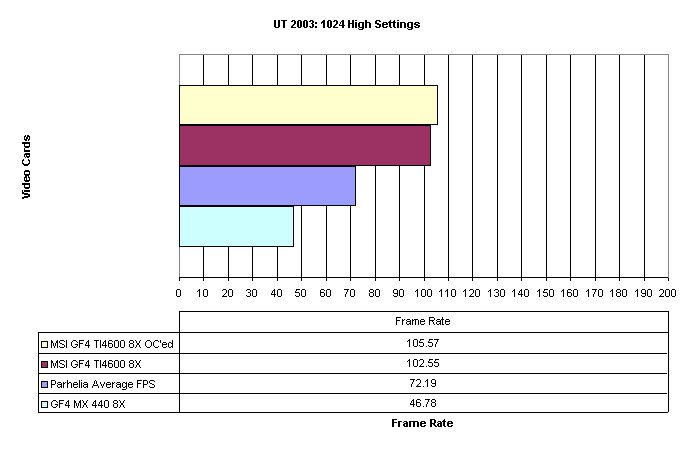
102.55
133
MSI GF4800 OC'ed
84
105.57
137
GF4 MX 440 8X
36
46.78
74
Parhelia
54
72.19
99
The results show that the Ti4800 doesn't lose it's grip on first place even in this newer game. The MX shows definite signs of fill rate limitations reaching it, with only two spikes reaching over 65 fps. Apart from three spikes the graph is fairly flat with few large drops in frame rate in the test. The Ti4800 does well and never drops below 80fps in the test and only drops below 85 fps once, though it is closer to its lowest frame rate than its highest, by about 11 frames. The card performs well with some wide variations in frame rate, going from 85fps in one second to 126fps in the very next. The Parhelia does well, beating the MX at 1024, just like it did in Max Payne. The largest difference in frame rate is when it goes from 93fps in one second to 54fps in the next, just under what the Ti4800 managed, apart from that there is a pretty smooth gradient as the frame rate does not increase by a large amount every second but rises in a natural angle.
Video Card
Minimum Frame Rate
Average Frame Rate
Maximum Frame Rate
MSI GF4800
16
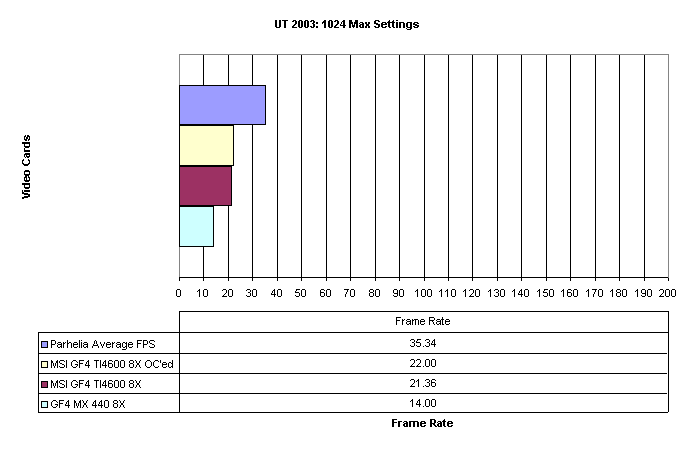
21.36
37
MSI GF4800 OC'ed
17
22.00
35
GF4 MX 440 8X
8
14.00
21
Parhelia
26
35.34
56
Here the results are similar to those taken in Max Payne when AA and ansiotropic filtering were enabled. The MX takes a definite nose dive but as it was already very close to the bottom it lost 70% of its average frame, which only translates into 32fps. The graph of the MX is obviously very flat with only three very small (7fps max) upward spikes, though the frame rate doesn't really get below the average. The Ti4800 doesn't fair much better, as it loses 79% of its average frame rate and comes within 8fps of the MX. The graph of this card is not as flat as with the MX with a couple of 13fps upward spikes, and again not much difference between its minimum frame rate and its average frame rate. The Parhelia due to its efficient AA technique manages to 'only' lose just over 51% of its average frame rate. The graph, while not having as much variation as it had without AA enabled, still has more variation than the rest of the cards tested at this resolution.
Video Card
Minimum Frame Rate
Average Frame Rate
Maximum Frame Rate
MSI GF4800
36
45.38
74
MSI GF4800 OC'ed
37
46.92
72
GF4 MX 440 8X
15
20.72
39
Parhelia
26
33.44
47
At 1600 the order returns to its standings from 1024*768. The MX isn't even playable at this resolution with a maximum frame rate of 39fps which it comes close to reaching in about 4 separate instances of two seconds or less. Apart from those spikes the frame rate largely stays within about 5 frames of the average frame rate. The Ti4800 does fairly well, providing what could be a playable frame rate in this demanding test. Apart from three short (one second) points, the frame rate never gets above 60fps though this keeps the range of the frame rate moving upward with a larger range still between the maximum frame rate and the average frame rate than that of the minimum/average. The Parhelia does okay, halfway between the MX and the Ti4800 and is probably playable in most of the levels in the game, apart from the most demanding ones (Antalus, Inferno) The graph of the Parhelia is somewhat flat, with it only reaching above 45 fps twice, and it only makes it above 40 fps a couple of times more. The difference between the maximum frame rate and average is slightly more than that of the minimum/average difference, taking into consideration the two highest points being omitted.
Video Card
Minimum Frame Rate
Average Frame Rate
Maximum Frame Rate
MSI GF4800
5
8.88
16
MSI GF4800 OC'ed
7
9.17
17
GF4 MX 440 8X
5
7.55
17
Parhelia
12
16.04
29
Here we see not one of the cards can deliver a playable frame rate. The MX as always, in this test, is last but the G4Ti4600-VT2D8X is close by it. The graph of the MX is predictably flat with only three points reaching over 15fps. The minimum frame rate is more common and it reaches it many times, with even a 5 second span where the frame rate was at this level. The G4Ti4600-VT2D8X doesn't fair much better with only two points above 15fps. However as we look at the graph we see the frame rate doesn't vary from 9fps all that much with only a couple of seconds where it reaches above or below that number. The Parhelia outperforms the rest of the pack by 75%, but considering the frame rate of the other cards this is more a paper victory than anything. Of all the cards the Parhelia shows the most variation in frame rate with four peaks of 25+ fps. Without those peaks however the Parhelia's average frame rate is about halfway between that of its minimum and its maximum.


 G4Ti4600-VT2D8X: With the GeForce FX still MIA, we take a look at their current flagship, the GeForce 4 Ti4600, souped up with AGP8x. The MSI version also breaks away from reference by including their own cooling system.