
Some people swear by silver based compounds, and others prefer the generic stuff. Does the fancy goop really work better, and if so, does the performance justify the price? From my experiences, exotic compounds do tend to perform better, but we're not talking about copper heatsink to aluminum heatsink type differences. In fact, the differences are usually negligable. Are these compounds worth the extra cash then? Again, this will depend on a few factors, such as how often you need to replace it.
Today, we're going to examine some of the new compounds by and . They will be compared to one another, as well as to their previous generation siblings. I won't bother going into too much detail about those, but you can read my previous Nanotherm Compound review here, and my Arctic Silver 2 review here. Rounding out the shootout, we'll be taking a look at some of the generic stuff that comes free with most heatsinks. You better grab a coffee, cause this is gonna be a long one...
The focus of the roundup will be on the newer products we've received here. Included will be the results from previous compound reviews. Knowing that, let's take a closer look at the competitors...
Nanotherm Ice and Blue

We looked at ESG Associate's last versions of Nanotherm, and came away quite impressed with it's performance. They've released a newer version now that is supposed to be a better performer, plus you get even more for the money. Like their previous version, ceramic based, and non-electrically conductive. You can read more about the specifics in our last review.

Like before, you have two versions to choose from, Ice and Blue. Like before, chemically, both products are identical, except for the coloured tint in the "Blue" version. Through testing, I've found that the blue is easier to apply, meaning, it was easier to tell when the right amount was applied. I'm not trying to say the "Ice" would be tougher, because it isn't, but the visual aid in the Blue makes it more obvious.
Here are the rest of the specifications from ...
Nanotherm Ice and Nanotherm Blue are unique nanocomposite polyceramic thermal interface compounds that contain a special blend of engineered materials, including Boron Nitride, Aluminum Oxide, Aluminum Nitride and other nanopowders, compounded into a proprietary multisynthetic carrier fluid comprised of USDA-approved "food grade" lubricants.
Nanotherm is now available in 2 gram tubes. Each syringe contains a volume of 1.5 cc/ml of thermal compound, providing a coverage area of about 30.5 sq. in. at an average layer thickness of .003". In terms of applications, each tube of Nanotherm contains enough thermal compound to cover:
32 to 44 small CPU cores
12 to 19 large CPU cores
5 to 10 heat plates
The following are some of the features, characteristics and benefits of Nanotherm Thermal Compounds:
Cost-Effective, High Performance Thermal Interface Material
High Thermal Conductivity
Low Thermal Resistance
Excellent High and Low Temperature Characteristics
Electrically Insulative
Non-Hazardous and Chemically Inert
Spreads Smoothly & Evenly in Thin Layers
Viscous, Sticky Consistency
Fills Micropores & Grooves on Contact Surfaces
Fast, Easy Cleanup - No Mess
Excellent Barrier Properties to Oxygen and Moisture
Resistant to Separation, Leeching and Drying Out
High Pressure Resistance
Transparent to Microwave Radiation
Something that wasn't mentioned when I previously tested the Nanotherms, was the new ones seem to require a break-in period. Scott @ ESG Associates fired this off to me...
"One thing we wanted to mention regarding the thermal compounds - there is a break-in period where the material is compressed by the clamp force from the HSF, spreading, leveling, densifying and so on. Consequently, the CPU and SYS temperatures will migrate lower over time and stabilize at temps distinctly less than after the initial application. This has always been the case with Nanotherm, because of it's material composition and thicker-than-average viscosity.
As I indicated above, the break-in period is typically a function of time (40 to 60 hours of use). The break-in period can be accelerated by cycling between full load and idle conditions for 2 - 3 hours, then shutting down for 2 - 3 hours and repeating the idle/full load testing and shutdown cycle again, followed by a final idle/full load test. We would recommend at least 3 idle / full load cycling sessions - 2 the first day followed by a prolonged shutdown period (overnight, for instance). The 3rd and final session would be the actual test session where you would record the data - allowing at least 20 minutes stabilization time at Idle and 20 minutes at full load before recording temperature measurements."
I wasn't sure initially if the temps would actually be higher at the beginning, but this will certainly be something we'll investigate during our tests.
Arctic Alumina

Arctic Silver shouldn't need any introduction for most of you. Well known for the original Arctic Silver, followed by Arctic Silver 2, they are often imitated, but rarely matched. The quality of their products is excellent, but one knock against them is the price. They hope to change that with the Arctic Alumina, which sells for about half of what Arctic Silver 2 sells for, and performs closely.
Unlike most generic compounds, Arctic Silver doesn't just shove white grease into a syringe. Alumina is composed of a layered composite of aluminum oxide and boron nitride. I'm no chemist, but according to them, this process produces performance near Arctic Silver 2 levels. If it isn't obvious by now, Arctic Alumina is not a silver compound like Arctic Silver 1 or 2 was. Here are the specifications from their site:
Arctic Alumina Compound uses a layered composite of aluminum oxide and boron nitride to provide near Arctic Silver II level performance.
Arctic Alumina Compound is a pure electrical insulator, neither electrically conductive nor capacitive.
Arctic Alumina Compound does not contain any silicone. The suspension fluid is a proprietary combination of advanced polysynthetic oils.
Arctic Alumina is sold in 1.75 gram tubes. This is enough compound to cover at least 25 to 35 small CPU cores, or 9 to 15 large CPU cores, or 4 to 8 heat plates.
At a layer 0.003" thick, it will cover approximately 24 square inches.
Although lighter per tube than Arctic Silver II due to its use of ceramics rather than silver, each tube of Arctic Alumina actually contains slightly more compound by volume than a tube of Arctic Silver II and will cover MORE area.
Arctic Alumina is engineered for controlled triple phase viscosity.
The complex polysynthetic oils work together to provide three distinctive functional phases. As it comes from the tube, Arctic Alumina's consistency is optimized for easy application in a thin, even layer. During the CPU's initial use, the Arctic Alumina compound thins out to enhance the filling of the microscopic valleys and insure the best physical contact between the heatsink and CPU core. Then the compound thickens slightly over the next 20 to 100 hours of use to its final consistency designed for long-term stability.
Note the last paragraph. Much like what was said by Nanotherm, there is a break-in period for Alumina. It's worded a little differently of course, but the idea is that it takes a few hours until the performance will level off.
I didn't mention it earlier, but one other knock I had on Arctic Silver was that it's extremely hard to clean. It isn't hard to get off the CPU die, but if you rub any on the rest of the CPU (Athlon XP owners will know exactly what I'm talking about), it can be really tough to get off. I didn't have any problems with the Alumina though. A bit of rubbing alcohol and a lint free cloth, and off it came.
Let's take a look at their new flagship compound...
Arctic Silver 3

I've been using Arctic Silver 2 for quite a while now, and pretty much stick to it as my primary compound. I like it because it's really easy to spot visually how much you've put on it, and it performs consistently. Nevin @ Arctic Silver dropped me a line not too long ago that the successor of AS2 is out, and it outperforms it.
Arctic Silver 3's claim to fame is that it's the first silver based, polysynthetic based compound on the market. Unlike their previous version, AS3 has no silicone. Although it's still silver, it has a goldish tint to it if looked at side-by-side with AS2. Here are the specifications directly from their site...
The first silver-based, polysynthetic thermal compound for use between modern high-power CPUs and high performance heatsinks or water-cooling solutions.
Arctic Silver 3 features:
Made with 99.9% pure micronized silver.
Arctic Silver 3 uses three unique shapes and sizes pure silver particles to maximize particle-to-particle contact area and thermal transfer. This exclusive combination gives the compound a distinctive silver-green color as each type of particle reflects light differently.
Over 70% silver content by weight.
Arctic Silver 3 also contains a small percentage of specially engineered micronized boron nitride. The thermally-enhanced boron nitride ceramic particles improve the compound's flow characteristics and long-term stability.
Extended temperature limits: 40°C to >160°C
Arctic Silver 3 will not run or separate.
Controlled triple phase viscosity.
Arctic Silver 3 does not contain any silicone. The suspension fluid is a proprietary mixture of advanced polysynthetic oils that work together to provide three distinctive functional phases. As it comes from the tube, Arctic Silver 3's consistency is engineered for easy application in a thin even layer. During the CPU's initial use, the compound thins out to enhance the filling of the microscopic valleys and insure the best physical contact between the heatsink and the CPU core. Then the compound thickens slightly over the next 50 to 200 hours of use to its final consistency designed for long-term stability.
Thermal conductivity: >9.0 W/m°K (Hot Wire Method Per MIL-C-47113)
Thermal Resistance: <0.0024°C-in²/Watt (0.001 inch layer)
4 to 15 degrees centigrade lower CPU core temperatures than standard thermal compounds or thermal pads.
Negligible electrical conductivity.
Arctic Silver 3 was formulated to conduct heat, not electricity. It is only electrically conductive in a thin layer under extreme compression.
(While much safer than electrically conductive silver and copper greases, Arctic Silver 3 should be kept away from electrical traces, pins, and leads. The compound is slightly capacitive and could potentially cause problems if it bridged two close-proximity electrical paths.)
Arctic Silver 3 is sold in 3 gram and 6 gram tubes. The 3 gram tube contains enough compound to cover at least 20 to 30 small CPU cores, or 7 to 12 large CPU cores, or 3 to 6 heat plates. At a layer 0.003" thick, the 3 gram tube will cover approximately 18 square inches.
Again, like everyone else, there is a break-in period. Application was a snap, but cleaning it was still tough to do.
That's it for the compounds, so before the tests begin, we'll look at the thermal adhesives we also aquired...
Nanotherm Thermal Epoxy
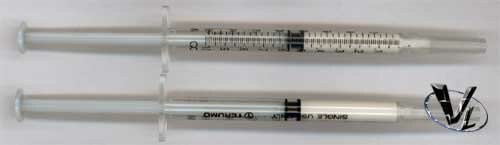
Scott @ ESG Associates sent over a sample of their prototype thermal adhesive. There isn't much documentation about it on their web site, but if you're familiar with epoxy application, this is applied in similar situations.
Arctic Alumina Adhesive
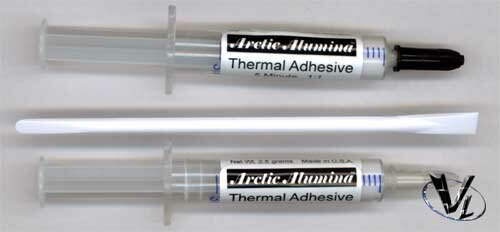
Nevin @ AS also sent us some adhesive as well. It should be noted that it is very clear on Arctic Silver's site that this product shouldn't be used on CPUs.
The epoxy comes in two syringes for both manufacturers, and must be applied in a 1:1 ratio. Having worked with epoxy a few times, my advice is to apply it quickly after mixing, as it gets harder to spread after. I used it on my video card heatsink, and the pressure from the HSF clips was enough to keep a firm grip. It takes about 5 minutes to set.
I probably should have mentioned this earlier, but both epoxy solutions are permanent. Because I needed to test both of them, and only have a couple of video cards to test with, I needed to dilute both mixtures. I'm still going to provide numbers for both of them, but because I'm changing the properties somewhat, my results may not reflect what you might see elsewhere.
To dilute them, I applied the 1:1 ratio for each. I then added an equal part of either Nanotherm Ice or Arctic Alumina (depending on which epoxy I was using) to the mix. It's still tough to separate after, but not as tough as it would be had I not diluted the mixture.
Ok, enough talk, let's get to the benchmarks...
The Test Bed
AMD Athlon Thunderbird 1.4GHz (1.75v), w/Vantec CCK-6027D
Abit KT7A-RAID, with socket thermal sensor touching the bottom of the CPU
Antec SX630 Case
Room temperature is maintained at ~23C/74F
The system above is my day to day network server, since I'm not currently LANning. I loaded up Seti, and let it run pretty much 24/7, and only checked the computer when I needed a temperature check. I'll be including scores from the last batch of compounds as a comparison to the newer ones.
AMD Athlon XP 1800+ (1.75v), w/Swiftech MCX462
Abit KG7-RAID, with socket thermal sensor touching the bottom of the CPU
Lian-Li PC60
Room temperature is maintained at ~23C/74F
This is my everyday rig, and where it'll be powered on and off to mimic the real-world use of most computers. I do all my gaming on this machine, as well as my web work, so I think it'll get a fair workout. This is also where we'll be testing the video card GPU temperatures.
As usual, testing conditions vary from user to user, and I've done my best to maintain a consistent testing environment. My results may or may not be similar to your own.
MSI StarForce 822 GeForce 3

We're starting with the video card temps first, since there isn't as much to talk about. I'm only including overclocked, full load results here, because if it can handle these speeds, and this amount of work, you'll be just fine.
Both the new version of the Nanotherm Epoxy and Arctic Alumina Adhesive slightly improve upon the previous version of the Nantherm Epoxy I used before. I had some problems applying the epoxies (both of them), which may contribute to the difference between those and the Arctic Silver 2. For the record, if you're the type to try out a bunch of GPU heatsinks, I think these epoxies would be better suited for things such as ram chips, motherboard chipsets, or for attaching anything you don't intend to remove often. Even though I diluted the mixtures, they were freaking hard to get off. Had I not done so, it may have improved the performance, but I never would have gotten the Crystal Orb off.
CPU Temperature Benchmarks
We'll begin with the Athlon 1.4GHz numbers, which will be running Seti@Home for the week of testing. The only time it'll be stopped is just for the temperature check.

The Thunderbird is a hot running chip, and should provide a challenge to any heatsink or compound around. As we can see above, there isn't much difference between the compounds, although the Arctic Silver 3 does pull ahead. I've included scores from our last roundup for comparison. It was interesting to see the new Nanotherms perform like the Nanotherm Prototype we looked at last time. This would lead me to believe they're similar, if not the same product.

I decided that we may as well overclock the chip to 11.5x133, and up the voltage to give a better workout. All the compounds do perform closely, but we see the gap widen between the silver compounds and the Vantec generic.
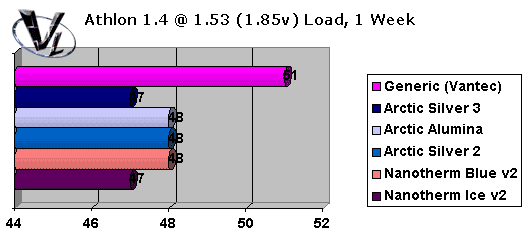
Allowing for a break-in period, we notice that temperatures seem to get lower by about one degree for all the compounds. I was a bit wary about this, as one degree falls within our margin of error, so we'll hold judgement until we view the Athlon XP results.

Before some of you freak out with the size of those graphs, remember that this is just one degree. As we've seen with the Thunderbird, temperatures fall within a degree of one another when idle.

Here, we see the Arctic Silver 3 holding strong in the lead, but all the others are close behind. The Alumina is trailing though, and this wasn't something I expected.

Pushing the XP to 11.5x140 forces everything to work a little harder. Both new versions of the Nanotherm hold the lead position with the Arctic Silver 3. Again, the difference between the leaders and the others differ by only a degree.
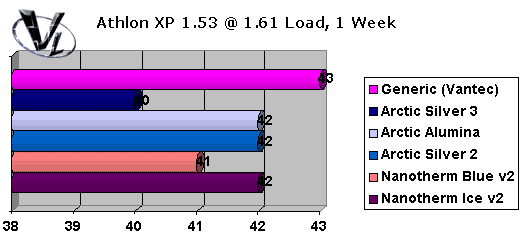
Allowing for the break-in period, everyone settles in on their final scores. Conclusion? Keeping in the Olympic theme, Arctic Silver 3 is our new gold medalist, with Nanotherm sharing silver with Alumina, and bronze finish by Vantec's tube of generic.
Final Words
Before getting to each product individually, I want to answer a few questions that I'm sure is going to be asked. Do these compounds really perform a lot better than regular paste, and is it worth it? To answer the first question, these exotic compounds don't really improve performance to a point that overclocking will become easier. Arctic Silver 3 does produce better numbers than the rest, but one degree may not be a big deal for some. As for the second question, both Nanotherm and Arctic Silver have lowered their prices since we last looked at them, but their products do cost more than the paste you probably got for free. The flip side though, that free paste isn't resealable, and is basically only used once. Change your CPU, you're still going to have to buy paste. You can buy a tub of grease of course, but I don't see why anyone needs that much, and what I liked about all these products, the syringes make for easy application.
: ESG Associates does live up to their claim that they've improved their Nanotherm products. It has also gotten bigger and cheaper. You can find a list of at their site. Between the two, my preference is the Blue. I found it easier to apply, and the consistency seems smoother than the Ice. The Nanotherm Epoxy was easy to work with and a worthy addition to the Nanotherm product line. I didn't like the packaging much for all the products though, as the plastic used for the syringes can crack if you accidently step on it, or if you did like I did, and shove it into a tool box full of heatsinks, and run to the car.


Ice (left), Blue (right)
: This isn't any regular paste. I found the product the easiest to apply and the easiest to clean. It doesn't perform up to Arctic Silver 3 levels, but it isn't supposed to. The texture was creamy, making for even applications a snap. The was also easy to work with, but I did find that it hardened a little slower than the Nanotherm.

: Great performer (really!), and easy to apply. The consistency is similar to the Alumina, and applying it evenly shouldn't be a problem. What I didn't like, which probably applies to all silver compounds, is that it can get messy. Cleaning it isn't easy, and it you get some on your hands without realizing it, you'll end up tracking silver fingerprints all over the place. A small price to pay for the performance though.
None of the reviewed products here contain any silicone, so they should not break down over time. All the products perform comparably, and are highly recommended by us. They don't blow away some of the better generic compounds, but they are packaged better, and given what I've seen, perhaps maintain their level of performance for longer periods of time.
If you have any comments, be sure to hit us up in our forums.
HOME


