Hard Drive performance
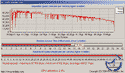
We are using HD Tach Version 2.61 for this testing. We will be comparing the ICH5-R solution used by Intel 865's to the IXP-300 employed by ATI. This should show us if SATA is SATA across different manufacturer motherboards as well as varying chipset solutions to SATA.
|

|
|
FIC
|
ABIT
|
The Abit AI7 has a much smoother transition line than the FIC P4M-RS350; you can see there is a great deal of variance on the FIC motherboard as compared to the Abit. This is a very interesting test in that this is the exact same hard drive in both tests, just 2 days apart.
Network Performance
Both motherboards employ the Realtek 81xx onboard LAN solution; let's see how the two fair using different NB/SB. We will be using DU Meter and a crossover cable between the two machines to test the throughput of several files varying in size between 300KB and 150MB. Total data transferred for this test is 3.29GB.
 |
 |
 |
 |
|
FIC Download
|
FIC Upload
|
ABIT Download
|
ABIT Upload
|
As you can see, the FIC maintains around 10.5Mb/Sec throughput on upload, that's nearly 84MB. Not bad use of a 100MB pipe. Download is slightly less at ~9.9Mb/Sec or nearly 78MB. Both upload and download used a maximum of 22% CPU utilization, primarily during the transfer the CPU was in the mid teens. Comparing to the AI7, we see similar download results and disparate upload. The P4M-RS350 outperforms here as the AI7 comes in at a mere ~7.88MB/Sec or nearly 63Mb, this is done however with drastically less CPU utilization. The AI7 maintained sub 17% during this test, with the primary CPU utilization hanging around the 7-9% range.
Audio Chipset Performance
We downloaded and installed Audio Winbench to test its CPU utilization. CPU utilization was fairly high throughout the DirectSound3D tests. CPU utilization got as high as 32%, and averaged in the 14%-18% range, which is a lot higher than the <2% averages we have seen with the nForce2. It's not a system killer, but we are getting close, as this is a 2.4GHz machine.
Audio Winbench is a synthetic benchmark, so let's play UT2004 and see how the system is affected with sound on and off.
I built a batch file to run UT2004 with and without sound at its lowest possible settings for the map "br-colossus". This should give us a good indication of the CPU hit when running a more true to life game over a synthetic benchmark. Tests will be done with the same hardware configuration as the rest of the benchmarks, except we will be only displaying the Intel P4 2.4C numbers.
640x480

The CPU takes a 9.1% hit during this test when enabling onboard sound. Not a huge hit on the CPU whilst running a video game. Keep in mind, the settings used are not going to be ideal if eye candy is important to you. Now let's see what happens when we set it up as a typical gamer might use it.
1024x768

When it comes down to it, at high resolution and detail levels, the onboard sound's CPU utilization should not be a factor.
In terms of sound quality, I inserted a few different DVD's and played back the good parts (Pirates of the Caribbean / The Matrix / Pearl Harbor) and tested the SPDIF out ( I happen to have a copper riser here) as well as the stock Headphone Jack. The reproduction with the SPDIF was of high caliber and gave my AR headphones good information to process. The stock Headphone jack was as expected, simple Left / Right sound with no spatial information, but up to par with others.
OverClocking
Nope, not in the BIOS for either the CPU or the Graphics. It's a MicroATX, what did you expect?
Final Words
FIC, along with ATI, has packaged a lot of punch in a small package. Although the graphics might not impress those of us with high end video cards, it is enough to get you playing a few games on the go. Performance does not compare with the Intel chipset brethren, but is not far enough behind that you could totally disregard it as a competitor.
The P4M-RS350 itself is a complete package that gives you the ability to upgrade the graphics when you have the money to do so. It carries competent performance and enough onboard solutions that voids the fact there is only 3 PCI slots available. The customer service however, makes me cringe with even the thought of it.
Pros:
Decent performance for an all in one (especially the graphics)
Expandable graphics with incorporated 8x AGP slot
SATA in a MicoATX
Cons:
CPU Utilization on Audio / NIC
Customer Service
Customer Service (Yes, we know we wrote that twice)
Bottom Line: The FIC P4M-RS350 is a fairly complete MicroATX solution, giving you plenty of memory space, CPU selection and the option to upgrade to a higher end Graphics card when needed. Lets just hope if you purchase this motherboard that you never have to contact FIC for assistance&
If you have any comments, be sure to hit us up in our forums.


