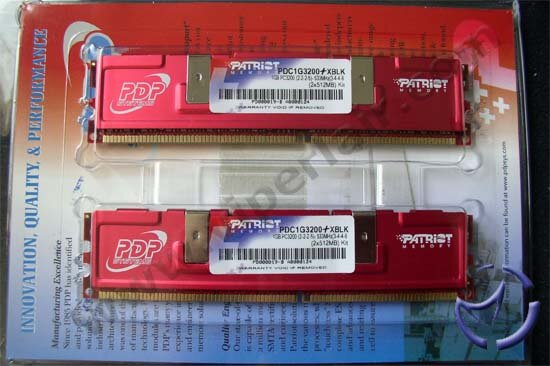
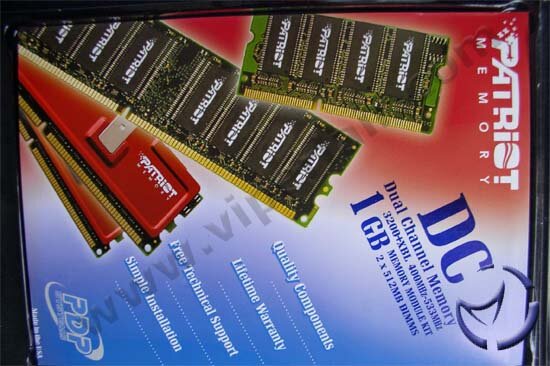
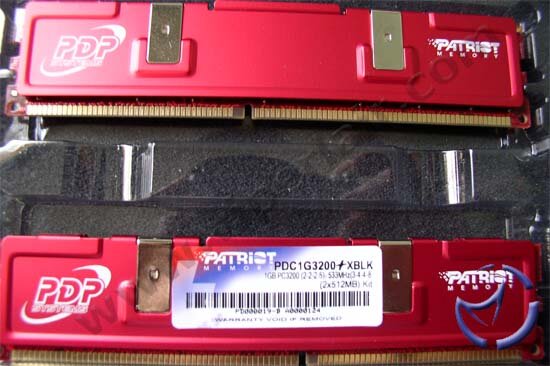
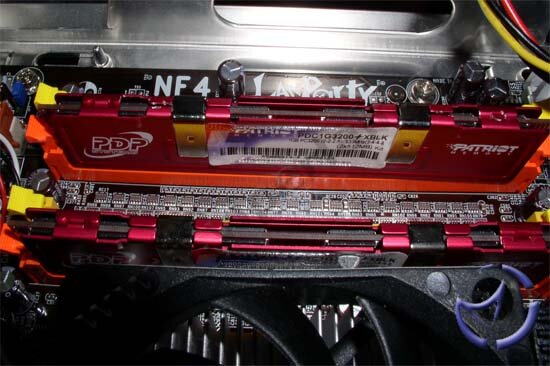
A relative unknown in the enthusiast market space, PDP Systems has released the XBLK line of memory packaged under the moniker of , with some very nice statistics to back it up. PDP Systems has been in the memory industry since 1985 and appears to piece together high end components to meet their consumer's needs. Before we dive into the current offering, let's take a quick look at what we will be testing.
Specifications
• PC-3200 / PC-4200
• CL 2-2-254 / 3-4-4-8 timings
• 2.6V
• Medium Red Heat spreader
• PDP Systems Lifetime Warranty
• Free Technical Support
Although DDR memory has been around for some time, it is nice to see another player arrive, especially when they come to market with some pretty tight timings and the ability to achieve PC-4200 speeds. PDP Systems primarily has been a major player in the global technology solutions provider space, and this appears to be among their first forays into the enthusiast's realm of memory solutions.
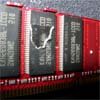
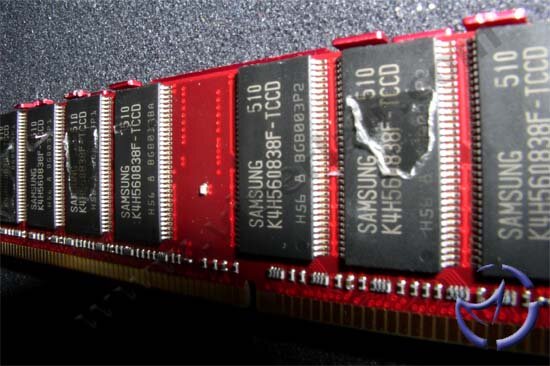
Removing the Maroon Heat Spreader takes more than just a little effort; I would highly recommend that in fact you don't. I was somewhat nervous waiting for the system to boot, thinking there was a chance I damaged the module in some way. Nevertheless I did manage to get the Heat Spreader off and take a snapshot of the internals. As you can see these are Samsung TCCD chips, dated for week 510. Interesting to note that they are now populated on a red PCB vise the earlier green PCB's, both of which appear to be mounted on a Brainpower PCB, which should assist in overclocking above and beyond the reference PCB. PDP Systems has rated these modules as 2-2-2-5 @ PC3200 as well as 3-4-4-8 @ PC4200.
Seeing as no respectable overclocking enthusiast runs things at “spec”, let's install them and see what we can do.
Test Setup
DFI LAN Party Ultra-D, Asus N5900 Extreme, WD 80GB 7200RPM SATA, AMD64 3200+ (Venice Core), OCZ PowerStream 420 PSU
Memory
Patriot Memory (2.7V / 2.85V) (2-2-2-5 / 3-4-4-8)
Kingston HyperX PC4300 (2.8V) (3-4-4-8)
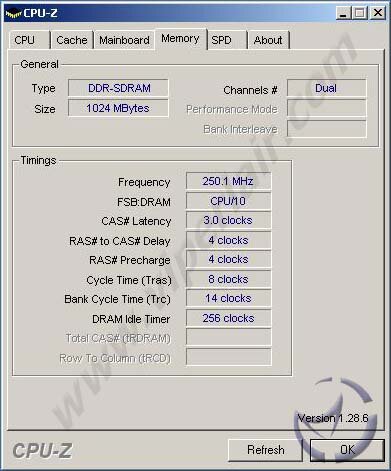
All though the timings at stock 400MHz speeds seem to favor the Patriot Modules, you can see they match up when you start Overclocking, we will see if this plays out through the testing phase of the review.
Testing software will consist of the following:
- Our standard synthetic test to establish a baseline.
- A good indicator of CPU/Motherboard performance is PiFast version 4.3, by Xavier Gourdon. We used a computation of 10000000 digits of Pi, Chudnovsky method, 1024 K FFT, and no disk memory. Note that lower scores are better, and times are in seconds.
- Video encoding is a taxing chore, both on the Memory and the Processor. We will be encoding a 150mb AVI file to MPEG2 on our test system. For the AVI to MPEG2 I used a bit rate of 5000k/Sec, as this is the midrange for a DVD, which is typically between 1000k/Sec to 10,000k/Sec. I used a frame size of 720x480 (DVD Std) and 16:9 NTSC. Note that lower scores are better.
Quake 3 - While it's old and moldy, it still has some value as a system level benchmark.
SiSoft Sandra 2005

At Stock speeds the Patriot Memory takes an initial lead. I attempted to tweak the HyperX memory modules to the same timings of 2-2-2-5 to no avail (I couldn't tweak them any lower than SPD). Even at 500MHz speeds, where the HyperX and Patriot modules where at the same timings, the Patriot modules still manage a slight edge (although the HyperX modules did gain ground).
PiFast

Once again the Patriot modules outperform the HyperX modules at 400MHz and again at 500MHz (with the HyperX again gaining ground), could this be a trend for the newcomer?
TMPGEnc MPEG Encoding

In this test scenario the two pair of sticks are very close with a slight edge going to the Patriot modules.
Quake III

The Patriot memory outpaced the HyperX once again, although not by much. Raising the frequency to 500MHz did little to change this with exception to bringing the HyperX a little closer.
Overall results of the benchmarks shows PDP Systems has done their homework with the +XBLK line and brought a serious contender to the still thriving DDR market space. I say welcome to the foray, as the more we as users have to choose from, the more we win.
Overclocking
Overclocking the DFI and different memory modules takes some getting used to. One memory set likes this setting, while the other can't even boot without that one. I managed through a lot of trial and error to get a very respectable overclock with the 3200+ Venice core and the Patriot memory modules. They are rated for 533MHz, I was only able to obtain a maximum POST of 526MHz, and that was with 3.0VDimm, a level I do not like to be at for long with anyone's memory. I was able to get to 420MHz (210HT) without adjusting the timings, once I tried 211HT I could not get past POST no matter what the VDimm was set to. With the Kingston HyperX modules I was only able to obtain a maximum POST at 514MHz. I was able to boot into windows and run tests on both modules at 500MHz (obviously from above results :P), however the Patriot Modules I was able to increase that to 510MHz. The timings on the Patriot modules could not be any tighter then 3-4-4-8, what PDP Systems rates for 533MHz.

Final Words
with its introduction of Patriot Memory +XBLK line takes dead aim at the DDR enthusiasts. They bring to market tight timings and flexible VDimm requirements to allow you to stretch the usability of a PC3200 Module to that of a PC4200 Module. A well done introduction into the market space, giving us yet another vendor for serious consideration when choosing our memory.
Pros: Tight timings and flexibility for headroom, Life Time warranty, Free Technical Support if needed
Cons: Did not reach the maximum rated speed, Cost, on par with OCZ / Kingston but without the reputation among enthusiasts.
Bottom Line: Patriot Memory has started off on the right foot, tight timings, great overclockability along with things you expect, such as lifetime warranty. Lets hope they continue this pursuit, as I enjoy being able to pick from more than one or two vendors when it comes to performance oriented gear.
HOME