Now that Microsoft Vista Beta 2 has gone public, and everyone and their brother has downloaded it. Of course, now they find out that their machine barely fits the bill, hence we are starting to see some more advantages to 2GB memory kits.
Not long ago, not only was a 2GB kit (2x1GB modules) of memory seem like complete overkill, it was typically lacking in performance due to higher latencies, especially when compared to a 1GB kit (2x512MB modules). Not only that, but it was more then 2x the cost of said 1GB Kit. The timings have gotten better, the prices have fallen, and no longer are we viewing them as overkill on a desktop, so let's take a look at Patriot's PDC2G PC-4000ELK 2GB DDR memory kit.

Patriot has provided VL with a pair of 1GB modules paced at PC-4000. A quick glance at the specifications and you quickly realize these aren't your 1GB modules from yesterday, so lets look over the specifications to see where they are pushing it:
Specifications:
- PC-4000 (667MHz)
- CL 3-4-4-8 timings
- 2.8V
- Red Aluminum Heat spreaders
- Lifetime Warranty
In the DDR arena, these are some pretty good timings (with exception to the TRAS timing), add to that the simple fact these are 1GB modules, and you're gaining my interest even more...

|
|
|
|
Stock
|
250MHz
|
SPD Settings
|
It appears the motherboard thinks the memory is capable of better timings then 3-4-4-8, as you see in the 1st CPUz picture above, SPD sets them to 2.5-4-4-7. When upping the memory to 250MHz (PC-4000 speed) SPD relaxes the timings to what they are rated, 3-4-4-8. Viewing the SPD tab, shows that is how Patriot has set the timings on the modules themselves...

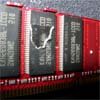
Now that we got that out of the way, lets go over the modules in a little more detail. Patriot has upgraded their look since I last reviewed their DDR Memory, IMHO, it is an upgrade. The heat spreaders are ribbed Aluminum, with a raised silver "PATRIOT" on one side.
Patriot has also included a manual for the modules, its actually a nice overview of what each number means and a quick synopsis of how to properly install the modules.

Overclocking
2GB kits have traditionally been harder to get good a overclock with, typically because their timings are already loosened up. To make sure I could get to the maximum ability of the memory, I left the CPU at stock speeds and only increased the memory speed.
I did not have much of a problem initially with the Patriot PC-40000 kit getting to 250MHz. Not even a bump in voltage was required from its stock 2.8V to get me there, granted, the timings have slipped to 3-4-4-8. Unfortunately, the A8R32-MVP Deluxe does not have a setting above 250MHz (500MHz DDR) to try and test further. The only thing I could do was try to tighten the timings and see what happens:
As you can see, I got the timings back to 200MHz settings of 2.5-4-4-7. Patriot does a nice job of performing at their rated speed while using tighter timings. Granted your mileage may vary depending on the system you put it in and of course the chips in your set.
Testing
I will be testing these modules on the previously reviewed ATI RD580 Chipset based Asus A8R32-MVP motherboard. I will be testing at stock speeds and at overclocked rate (maximum attainable by Patriot). Without further ado, here is the test bed:
Asus A8R32-MVP Deluxe
HIS Radeon X1600Pro IceQII Turbo
WD 250GB 7200RPM SATA-II
AMD Opteron 148 (Socket 939 / 2.2GHz)
Asus A55G 550W PSU
Memory:
2GB Kit Patriot PC-4000 (2.8V) (2.5-4-4-7 / 3-4-4-8)
1GB Kit Patriot PC-3200 (2.8V) (2-2-2-5)
When you set them next to each other (the CL values) you can see an advantage going to the 1GB Kit, we shall see if this plays out through the testing phase.
SiSoft Sandra 2005
Although a synthetic benchmark, it's a popular one, freely available if you wish to make comparison benchmarks. We will be testing the memory speeds at stock 3.2GHz (667MHz) speeds as well as 4.0GHz (833MHz) OC'd .

The results are interesting in that as expected, the 1GB Kit outperforms at stock speeds.
PiFast
A good indicator of CPU/Motherboard performance is PiFast version 4.3, by Xavier Gourdon. We used a computation of 10000000 digits of Pi, Chudnovsky method, 1024 K FFT, and no disk memory. Note that lower scores are better, and times are in seconds.

This is a pretty close contest, less then ¼ of a second between, fairing well for the 2GB kit.
TMPGEnc MPEG Encoding
Video encoding is a taxing chore, both on Memory and Processor, we will be encoding a 150mb AVI file to MPEG2. For the AVI to MPEG2 I used a bit rate of 5000k/Sec, as this is the midrange for a DVD, which is typically between 1000k/Sec to 10,000k/Sec. I used a frame size of 720x480 (DVD Std) and 16:9 NTSC. Note that lower scores are better

In this test scenario the two pair of sticks are evenly matched, I must say, I was pleasantly surprised when I saw the results. The only thing I can think of here, is that the additional 1GB of memory somehow helped out during the encoding, as the faster timings of the 1GB kit should have outperformed...
Quake 4

Memory performance does play a role in gaming performance, especially a game that is as hard on an overall system as Quake 4 is. I wanted a "real world" test and Quake 4 appears to have fixed their demo program, it had to be my game of choice for this measurement. Interestingly, once again the 2GB kit outperforms the tighter timings of the 1GB kit. I knew Quake 4 was a memory hog :).
Final Words
While we have covered the 1GB or 2GB debate before, Vista is fast approaching and the beta is here. While there is no current application demanding 2GB at this time, it is plain to see this requirement is already on the horizon. Does this mean you have to dump your current kit for a 2GB one even if you're satisfied with the performance? I would hedge on wait and see, although, if you are purchasing new...
As we mentioned, nothing currently is requiring 2GB, however, we here at VL are not the types to settle for a software manufacturer's recommended ram requirements. Our general rule is whatever they say you should have, double it. Patriot has made the decision between a 1GB or 2GB kit that much tougher. As these modules are coming across as cost effective and apparently no longer limiting your overclocking desires.
Although I have been running on 2GB for only a short time, it is glaringly apparent that when running Vista Beta 2, they were not only a help, they made the all the difference in the world.
Overclocking was nothing short of impressive, tight timings and great speeds, gives you some headroom if needed. With performance, looks and overclocking agility, Patriot once again launches a highly competitive solution that just happens to be a 2GB kit instead of 1GB.
Flaws are few, and they revolve around documentation. No information on the Vmem anywhere in literature, therefore we do not know what the voltage ratings are, where can we push this and how far while still being under warranty? That said, there is some great overclocking ability ( 250MHz @ 2.5-4-4-7), and looks very nice with the heatspreaders. Patriot once again is knocking on the "big boy's" doors, by building 2GB Kits that are cost effective and overclock well.
If you have any comments, be sure to hit us up in our forums.
HOME