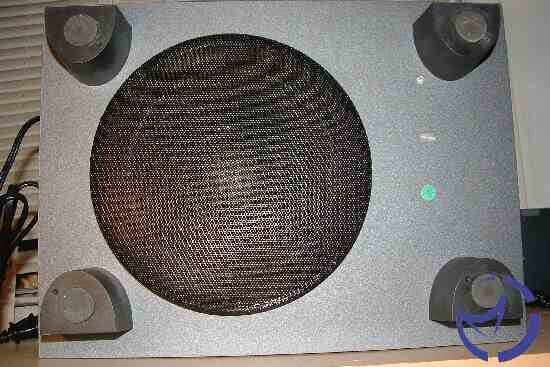
Moving on to the sub/amp we see that it is a down facing, side ported subwoofer. The front of the sub has the IR receiver as well as the volume display. The side of the sub is bare except for the air port on the right side of the sub. The back of the sub is the location of all the inputs and speaker outputs, as well as the power switch. Moving inside the sub we see the subwoofer, with the power adaptor right in front of the sub. To the upper right is the tuning port, and in front is the connector for the IR receiver and volume display. Looking at the amp portion of the speaker we see that it is very simply laid out, without much in the way of heatsinks, unlike my other sub, which has a large heatsink on the back of the sub. The cables inside the sub are the amplified sound to the different speakers as well as the front panel of the sub. Like the speakers, the sub is magnetically shielded, which is odd for a subwoofer. The actual sub is an 8" speaker, inside a MDF enclosure, held together with plenty of glue again. Now lets take a look at the back panel by itself.
Moving from the bottom right in a counter-clockwise direction we see the power switch, nothing really special there. Next is the line-in which has the six different channels all marked clearly, from left to subwoofer, using standard RCA cables. Lastly there is the speaker outputs, for the speaker wire. They use the quick connector for the wire, with the five separate connectors for the five different speakers that you connect to it. Now that we've looked at the product, lets see how it sounds, because if it looks cool but sounds bad, then its a useless product. So lets see the results.
Benchmark System
| CPU: |
AMD Athlon XP 2500+ (1833MHz) Barton Core
|
| Motherboard: |
Asus A7N8X-E Deluxe Bios 1008 |
| Memory: |
1 - 256MB Corair PC3200, 1 - 256MB OCZ PC3500 - (133MHz, 2-2-5-2)
|
| Hard Drives : |
40GB Maxtor 6E040L0, 40GB Maxtor 6L040J2, 2*80GB Maxtor SATA 6Y080M0
|
| Video Card: |
ATi AiW Radeon 9000 Pro - 64MB |
| Operating System: |
Windows XP Pro SP1 - DirectX 9b |
| Drives: |
Asus DRW-0804P 8X DVD +/-R/RW |
| Cards: |
Creative Labs Sound Blaster Audigy |
| Cooler: |
Alpha PAL-8045T |
| Case: |
InWin Q500 |
| Power Supply: |
Sea Sonic SS-400FB |
| Software: |
Winamp 2.81 |
Unreal Tournament 2004 |
|
WinDVD 4 |
Splinter Cell: Pandora Tomorrow |
|
Tested Speakers |
| Receiver: |
|
Edifier R501 AMP |
| Front Speakers: |
Quest Q660 (20-120W @ 6ohms) |
Edifier R501 (6W @ 8ohms) |
| Center Speakers: |
Quest Q3.4C (15-70W @ 6ohms) |
Edifier R501 (8W? @ 8ohms) |
| Rear Speakers: |
Fusion F-2 (40W @ 8ohms) |
Edifier R501 (6W @ 8ohms) |
| Subwoofer: |
(100W @ 4ohms) |
Edifier R501 (30W @ 8ohms) |
For audio testing we used two different songs, first Tchaikovsky's 1812 Overture with real canons, and bells. Secondly We tested a "Weird Al" Yankovic song UHF from the CD Greatest Hits Volume II. For the five channel test we used Star Trek First Contact, the first battle scene between the Borg and Federation. We also tested using two games UT2004 and Splinter Cell Pandora Tomorrow, to test positional audio (Splinter Cell) as well as the subwoofer (UT2004).
The sound levels between the two systems were basically equal, at about 75dBA from the listening point. For UT2004 I ran through a couple of levels, with the audio set in H/W 3D + EAX mode. With Splinter Cell I ran through the final part of the U.S. Embassy level, with the audio virtualization set to high, 3D Audio enabled and EAX HD enabled. Now lets look at how our tester found these speakers.
Test Results
First lets get a quick look at my impressions of the two systems with the two test games. I found that both systems managed to place the sounds of the games accurately, with the sub working pretty well with the rocket launchers' boom coming through very well. One thing I did notice is that both systems started breaking up after a little while. The Edifier speakers broke up much quicker, after about 5-10 minutes, but the other speakers also eventually started breaking up, though not quite the same problems as the Edifier system and not as quickly.
Now is the music/DVD testing. One common problem shared by both systems is that the bass power was severely lacking. First the impressions of the Edifier speakers. The symbols in the 1812 Overture were very clean and crisp, this is interesting considering that the speakers do not have a tweeter in any form. The horns in the music were somewhat dull sounding, while speech had a slight bit of hissing in it. The overall sound was very bright, while it was bordering on the harsh.
Now for my patchwork system. The overall sound was very crisp, though there was some harshness when there were horns and the like. Symbols however were weaker than the Edifier speakers, with less resonance to the sound as they didn't continue on after the initial sound. There was a good bit of hissing in some of the music at the higher end of the range. Overall the Edifier speakers seemed to offer better sound quality but had a little bit of a problem with games, which used a lot more bass.
Conclusion
We've looked at all parts of these speakers, so lets take a quick look at what we have found.
First the packaging, what do we see? The box that the speakers come in is pretty big, but to hold a 8" subwoofer, and five speakers it is expected. Everything in the box was packaged very well, with nothing loose, except the manual which didn't matter. The products included with the speakers was as complete as you could find, with 5 sets of speaker wires, of varying lengths. The inclusion of RCA cables to connect either a computer or other six channel system was nice, as was the included remote with batteries.
The actual units themselves are also something to look at. The satellite speakers were all identical, at least they seemed to be anyway, though the center channel was supposed to be slightly more powerful. They were all made of MDF, a standard for many speakers, and relied on a single woofer for all frequencies above the range of the sub to about 20KHz. The sub was a rather large beast, as long as the 10" Kenwood sub we used otherwise, but about half as tall as the other sub. The amplifier portion of the Edifier sub didn't have much in the way of heatsinks on the various components unlike the Kenwood, which has a large aluminum heatsink protruding from the back of the unit, though the Edifier sub didn't get too warm. The back of the unit has all the connectors properly labeled, but I was a little disappointed that there was no optical or digital inputs, as this would have meant a one cable install.
Now for the sound quality of the unit. Quite frankly I was pretty surprised that it sounded pretty good in both music and DVD's, with nice highs even without a single tweeter. For gaming I did notice that it started to crackle after a short time, making gaming something that isn't quite a recommended pursuit with these speakers, though the sound card did have something to do with this.
Now on to the most important area of all, price. The price is near $100 US, which when you compare it to offerings from Altec Lansing and Creative Labs, and Logitech it is pretty close to the others. With what you get from the Edifier speakers, 8" sub, IR remote, and all wood speakers, makes it a pretty good value for the budget minded 5.1 speakers.
Good Points
- Good quality sound
- All wood system
- 8" subwoofer
- IR remote
- All speakers/sub magnetically shielded
Bad Points
- No Tweeter
- Some sound issues in games
- No Digital/Optical in
- No real center channel (not marked)
Final Words
This system has all the basic features that you would look for in a speaker system, wood based, large subwoofer, and decent speakers. While they might not be the most power system in the world they provide very nice quality, the only things I'd add is a true center channel and tweeters to the speakers.

If you have any comments, be sure to hit us up in our forums.
HOME