When shopping for a new video card, you'll likely fall into three categories... non-gamer, casual gamer, and serious gamer. Non-gamers will either pickup the cheapest card they can find, or use whatever is bundled or integrated into their current PC.
Casual gamers on the otherhand can probably get away with a $100 to $150 card. In this price range, there are a lot of choices as you'll find dozens upon dozens of low to mid ranged cards fighting it out for your cash. Framerates are important, but so is the bottom line, and blowing half a grand on a video card is probably not a priority.
If you're a hardcore gamer, you'll have to expect to pay a little more as the latest action games (as well as almost every other category from strategy to role-playing) are demanding more out of your hardware than ever before. At this price point, the choices are a little more clear cut, as both NVIDIA and ATI have enthusiast level products aimed directly as this segment of the video card market.
Today, we'll be taking a look at the , which is an enthusiast level PCI Express part. As you can gather from the name, this video card is based on ATI's flagship X800 XT VPU. To checkout the rest of the card's capabilities, refer to the ASUS link, or read the specifications below.
| Specifications |
|
" Chipset Feature ATI Radeon X800XT VPU (visual processing unit)
SMARTSHADER" HD increased maximum shader instruction count to 1,536 from 160; new high-performance shader compiler
SMOOTHVISION" HD improved AA and AF performance for HD resolutions; 12X effective Temporal MSAA generates the sharpest and clearest images
VIDEOSHADER" HD integrated shader features to provide unprecedented support for digital and high definition video.
HYPER Z" HD enhanced Hi-Z buffer for improved performance at HD resolutions
3Dc" provided image enhancement & acceleration technology resulting in high polygon characters and scenes
128-bit, 64-bit & 32-bit per pixel floating point color formats
Microsoft® DirectX 9 and OpenGL 1.5 support
AGP 8X support
" ASUS Innovation
ASUS GameFace"Live for real-time video/audio communication
ASUS Video Security"online for building private security system
ASUS On Screen Display allows you to instantly change various 3D settings in almost any PC game without the need to quite the game
High-quality TV output for big screen gaming or presentations
DVI output for easy connectivity to digital flat panel display
Diversified displays connectivity (DVI, Dual VGA, DVI+VGA, DVI+TV-out)
|
The ASUS Extreme AX800XT
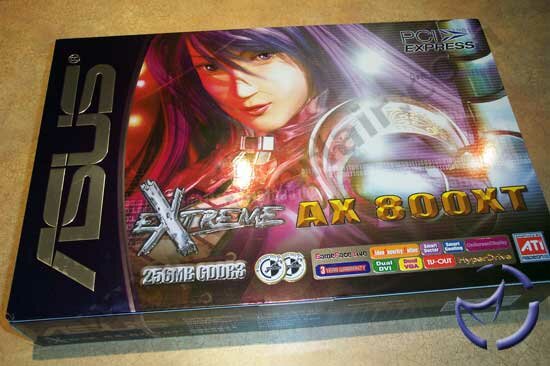
The ASUS Extreme AX800XT is packaged in a huge box with some nice artwork, and a listing of the card's specifications and capabilities. Inside, you'll find a driver CD, productivity software (full list ), a manual, a plastic CD case (containing most of the software) and Deus Ex: Invisible War.
In terms of hardware, other than the AX800XT video card, ASUS includes a 9 Pin S-Video to composite VIVO cable, two DVI-to-VGA output adapters, a 6-pin power splitter, and a webcam. The webcam is USB based, and is capable of 300K pixels resolution.
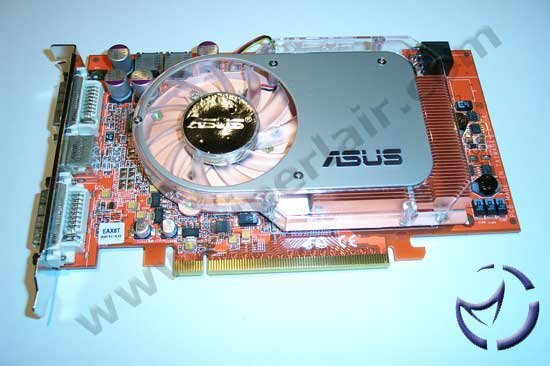
The ASUS Extreme AX800XT is a "standard" sized card, and should have no problems fitting into full height systems. The ATI Radeon X800XT VPU is a native PCIE processor, and is clocked at 520MHz. This is ATI's topflight part, and has 16 pixel pipelines with hardware support for DirectX 9B and Shader Model 2.0.
Cooling is provided by a large copper heatsink and LED fan combination. The card itself is very heavy, mostly due to the cooling apparatus. Although it is not as large as some NVIDIA 6800 coolers, the cooling on the Extreme AX800XT is not quite a one slot cooling solution. Depending on your motherboard, there may not be enough clearance between the PCIE 16X slot and the adjacent slot.

As we can see above, with our ASUS P5AD2 Premium, the fit is pretty tight.

The Extreme AX800XT uses Samsung's K4J55323QF-GC20 GDDR3 (Part number ). According to Samsung's specifications, the BGA ram is rated at 500MHz (1GHz DDR). The AX800XT, while a full fledged X800 XT, is not a Platinum Edition part, as that version of the card uses 560MHz ram. ASUS clocks the AX800XT at the maximum ram speed, so at the moment, we're not holding our breath for overclocking potential.

A 6-pin power connection is used to give the extra juice needed to operate the card. Using the 6-pin splitter, simply plug in two 4-pin Molex connections, then plug the splitter into the card.

For your input and output options, moving from left to right is the secondary DVI output. Next to it, we have the video-in, followed by the primary DVI. If you have analog monitors, you can use the two DVI-to-VGA adapters instead of the digital outputs.
Test Setup
ASUS P5AD2 Premium: Intel Pentium 4 560 (3.6GHz), 2 x 512MB Corsair XMS5400 ProSeries DDR2 (4-4-4-12), ASUS Extreme AX800XT, 160GB Seagate 7200.7 SATA, Windows XP w/SP1, Catalyst 4.9.
We'll be using FRAPS to record framerates in all our tests, playing the game as anybody would (trying to stay alive), firing weapons, dodging attacks and so on. Unlike our past video game tests, all benchmarks will be done with the audio "on", as we're trying to illustrate real gaming experiences, and I doubt any of our readers mute the audio during gameplay.
Test Software will be:
Doom 3 - Making good use of the BFG, rocket launcher and plasma gun (the most graphically intense weapons), we'll be killing demons on the map Delta2a. We'll also be demonstrating multiplayer performance.
Far Cry - Another graphically intense shooter, we'll be fighting baddies in the Swamp level.
Painkiller - If you're looking for flat-out action, this game provides it. The City on Water map will be used for benchmarking purposes.
The driver settings were manually configured for AntiAliasing and Anisotropic Filtering (on or off), and set to "Quality". All games were set to their highest allowable game settings. Unless otherwise stated, all games will be played at 1280x1024.
NEXT