has a reputation among enthusiasts as makers of some of the best ram in the business. Over the years, as ram technologies change, as well as getting faster, Corsair was always out there, putting out products to meet the demands of power users.
While DDR-II is still trying to gain mindshare, DDR-I is still very popular, particularly amongst AMD users and Intel Socket 478 owners. If you're lucky enough to own a setup that can hit 250FSB and beyond, you'll know that PC4400 ram can go a long way in maximizing your overclocking potential. The problem with ram at these frequencies however is that the memory timings needs to be relaxed in order to reach these speeds.

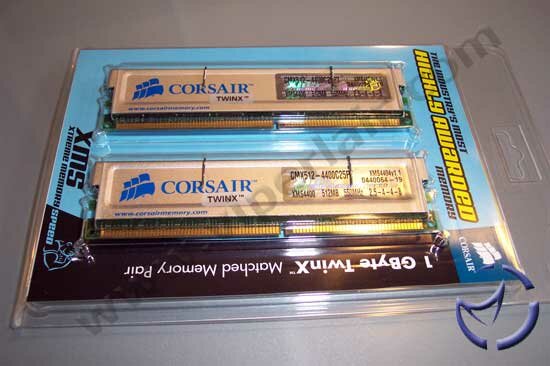
Today we'll be checking out Corsair's latest DDR550 kit, the TWINX1024-4400C25PT. As the name implies, this is a 1GB TWINX kit rated at PC4400, but unlike their previous kit (3-4-4-8 timings), these new modules are rated at 2.5-4-4-8.
Specifications
|
Part Number
|
Speed
|
Size
|
CAS Latency
|
|
|
XMS-4400
|
1GB
|
2.5-4-4-8
|
You can view the full specifications in this , but what you need to know is the modules are validated with an ASUS P4C800-E motherboard at 550MHz. Since the memory controller operates at 400MHz stock, the ram has a lot of headroom if your CPU and motherboard have high overclocking ceilings.
The ram modules arrived in a hard plastic case, with each ram module fitted in the clear plastic shell. The only reason I'm pointing this out is because there should be no confusion in what you're getting. You have a clear view of the ram, and the labels (indicating the type of modules), and the packaging is snap sealed.
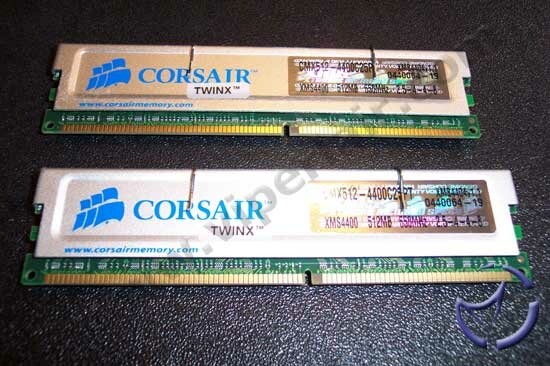
The TWINX1024-4400C25PT modules have platinum coloured heat spreaders. The TWINX1024-4400C25 kit feature the same modules, except they're encased in black heat spreaders. Sounding like a broken record, heat spreaders have yet to convince me that they effectively cool ram to the point where it will make a difference in overclocking, but I guess any cooling included won't hurt. We have been told that heat spreaders will reduce EMI since it shields the ram from noise inside the case, but I don't have any quantitative proof of that.
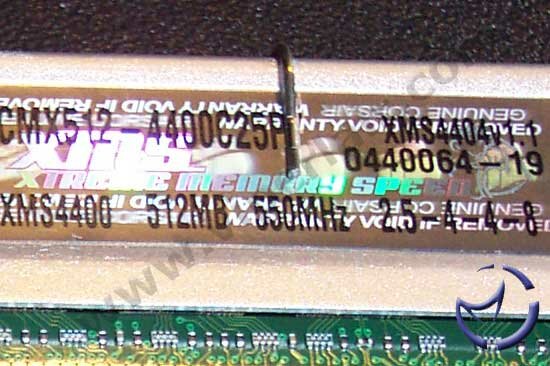
A closer look at the modules, and we can see the silver sticker letting you know the specs of that stick of ram. We can see that it's a 512MB stick, rated at 550MHz, with ram timings of 2.5-4-4-8. As many enthusiasts know, tighter timings (say 2-2-2-6) result in better performance, but as memory speeds increase, it is extremely difficult to maintain stability with such low timings. To be honest, timings seem to be having a lesser effect on performance as memory speeds increase as this was something we've observed with our past reviews, but nonetheless, any reduction in CAS latency (so long as it's stable) can only be a good thing. One thing to note is Corsair claims these modules are capable of 2-2-2-5 at DDR400, so if your current setup cannot hit 275FSB, these modules will still run very fast at stock, and have the potential to run quickly at higher speeds. How do they manage that? It just so happens that the actual memory modules used in this kit are the same found in Corsair's low latency 3200XL kits.

All of the TWINX kits are tested in pairs and in a Dual Channel environment, and although the ASUS P4C800-E validates the modules for DDR550 operation, all their modules are tested on various 875P, 865PE and Socket 939 based AMD motherboards for compatibility.
Overclocking

A will be used to test for reliability as well as stability during our overclocking tests. The card is quite expensive, but if you're testing a lot of ram, or you're a technician troubleshooting systems, this card is well worth the money.
How it works is that the R.S.T. Pro2 goes into a free PCI slot and after POST, it bypasses the OS completely, loading a proprietary OS and software package (embedded on the card itself). The card allows you to perform stress and performance benchmarks without the Operating System's memory footprint, memory resident programs, or drivers interfering with the memory installed. We'll provide a full review in the future, but that is the gist of it.
We proceeded with overclocking, and tested the ram via the memory tests on the R.S.T. Pro2 until we got a failure. In order to maximize our OC potential, we used a Pentium 4 2.4C which has a low multiplier of 12 and will allow a bit of FSB headroom on our ASUS P4C800-E motherboard.
|
Timings
|
Max OC
|
Pass R.S.T. Pro2
|
2-2-2-5
|
217
|
No
|
| 2-2-2-5 |
213
|
Yes
|
| 2-3-3-6 |
242
|
Yes
|
| 2.5-3-3-6 |
271
|
No
|
| 2.5-3-3-6 |
265
|
Yes
|
| 2.5-4-4-8 |
278
|
Yes
|
| 3-4-4-8 |
282*
|
Yes
|
While we did not include every overclocking test in our results above, we did include some that were worth noting. Two of the above results failed our R.S.T. Pro2 tests, yet they did run fairly stable nonetheless. Note that I said "fairly". While we were able to perform benchmarks, occasionally we would lock up the system, even though it succeeds in completing the failed benchmark in later attempts.
At 282FSB, the memory passed the R.S.T. Pro2 tests, but only when the vDIMM was pushed to 2.7v and we placed an 80mm fan on top of the modules. Without the additional cooling, the ram would fail the R.S.T. Pro2 tests, but the system would still indeed POST and get into Windows. The system wasn't very stable though, and without the extra cooling, the setup was happiest at 280FSB.
Test Setup
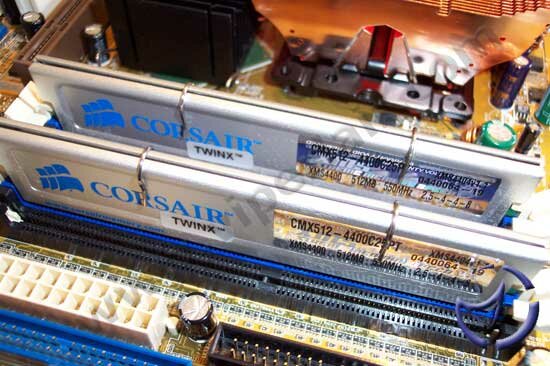
ASUS P4C800-E: Intel P4 2.4C, 2 x 512MB Corsair TWINX1024-4400C25PT, ATI 9600 XT, 120GB Seagate SATA 7200rpm, Windows XP SP1, ATI Catalyst 4.10.
The testing configurations will be as follows:
DDR400 @ 2-2-2-5
DDR542 @ 2.5-3-3-6
DDR550 @ 2.5-4-4-8
DDR564 @ 3-4-4-8
Testing software will consist of the following:
SiSoft Sandra 2004 Memory - Our standard synthetic test to establish a baseline.
Aida 32 Memory Tests - New to our test suite, this is another synthetic test to support (or discredit) our SiSoft results.
PiFast - A good indicator of CPU/Motherboard performance is version 4.2, by Xavier Gourdon. We used a computation of 10000000 digits of Pi, Chudnovsky method, 1024 K FFT, and no disk memory. Note that lower scores are better, and times are in seconds.
Quake 3 - While it's old and moldy, it still has some value as a system level benchmark.
SiSoft Sandra 2004 Memory

No surprises here as we see the performance scales proportionately with the clock speed. We also see that memory timings seem to have a lesser affect as FSB increases as well.