|
The All-In-Wonder series have been a great success for ATI. Recently, they've been coupling some great TV-Tuning functionality with a modern VPU. This is a far cry from early All-In-Wonders (AIW) where the VPU was based on a handicapped version of their fastest card.
Another smart decision was releasing different variants of the AIW cards, each targeting a different market segment. The AIW VE is still aimed at the budget market, where potential users may not have an AGP slot available. This AIW lacks a remote, and uses a two year old VPU, but it was priced very low, and the multimedia features matches the higher end AIWs. The AIW 9000 is another mainstream part, but unlike the AIW VE, it supports DirectX 8.1 gaming. This card suffered something of "middle child syndrome" and didn't seem to get as much fanfare as the other AIW parts. The AIW 9800 Pro is ATI's current top dog, matching their quality multimedia features with a faster 9800 Pro VPU.
Though the VPUs (and hence, the price) differed, what all three cards had in common was the TV-Tuner and the Theater 200 Video Processing Engine (VPE). Another thing they had in common, was the inability to output to dual CRT monitors. Considering that multimedia authors live and die with multi-displays, this was quite an omission in the AIW series. The AIW 9600 Pro, which we've reviewed last year, includes DirectX 9 support, Theater 200, FM-Radio (a new feature), and the previously MIA dual CRT display support. Today, we'll be looking at the newer , compare its features, gaming performance, and image quality with the card that it's replacing.
Specifications
You can grab ATI's , but I thought it would be good to outline a few important features.
TV-ON-DEMAND: Exactly as it sounds. With the AIW 9600 XT, you can record your favorite programs, and pause live TV (playing it back whenever you want) directly on to your hard drive. The Gemstar GUIDE Plus+ is a software and web based application that works much like a TiVO's TV guide. Unlike TiVO, there is no subscription fee for this service.
FM-ON-DEMAND: Introduced with the AIW 9600 Pro, the AIW 9600 XT has the ability to listen to and record live radio. This works by attaching an antenna to the IO panel on the card.
Unlike with the AIW 9600 Pro, this antenna is now included. Reception will vary depending on your location and where the antenna is placed. Ideally, you'll want to keep clear of any electrical lines near your PC and inside your walls.
THRUVIEW: Like other AIW cards, you can view TV through a translucent overlay on your desktop. This will allow you to work on your primary window, while still being able to watch TV. In theory, this sounds great, but I found it too distracting to use in a practical environment.
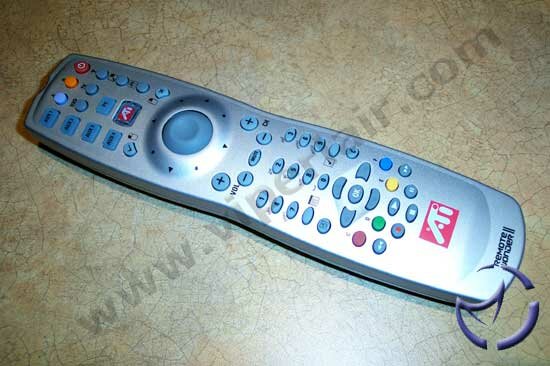
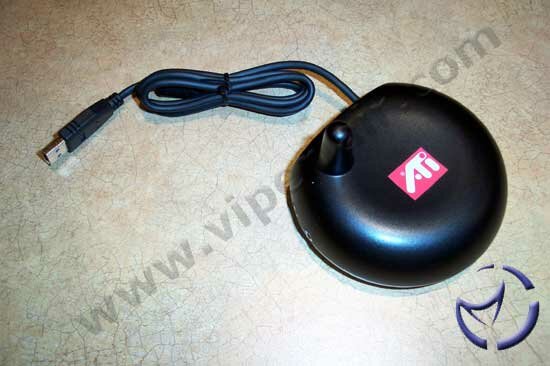
Remote Wonder II: A fully wireless remote, that works by radio frequency, rather than infrared. That means the signal will pass through most walls found in homes, and at a range of about 60 feet.
The button layout has changed from the original Remote Wonder, and key placement is logical. The USB receiver is much larger now, though not terribly awkward where placement will be problematic. The longer USB cord will make it easier to place the receiver in your ideal location.
EAZYLOOK: Also known as the "10 foot interface". An issue with past ATI TV-Tuning based setups was the interface was too small to read on an actual television set. Add the typically low resolution of TVs, and you can see the problems. EAZYLOOK uses a much friendlier and simplified menu, and the font size is much larger, making it easier to use.
EASYSHARE: Introduced with Multimedia Center 8.8, EASYSHARE allows you to share live TV and any captured video and audio content with other computers on your home network that have a modern Radeon VPU.
DirectX 9: The AIW 9600 XT offers full DX9 support.
The ATI All-In-Wonder 9600 XT
The AIW 9600 XT ships in the now familiar square-ish box. All of the product features are clearly indicated on the rear of the box, and on the front, we have a list of the included software. Sadly, no voucher for Half-Life 2 is included, and this is a trend we're seeing more of from many vendors of ATI products where this voucher is not provided anymore.
Inside the box, everything is neatly packaged in their own cellaphane bags, with the video card in an anti-static bag. There is documentation, software CDs, and all the accessories for the card. ATI also includes three batteries for the remote, which will save you a trip to the local Radio Shack.

|

|
The layout of the AIW 9600 XT is very clean, and like all 9600 Pro/XT cards, no external power is needed to operate the card as the 9600 series consumes less of it. The back IO panel contains all the connections needed to use the card. You have the TV-Tuner and antenna connections, and a video-in connection. There is also a connection for a dongle used for A/V input and output.
Based on the RV360 VPU, the AIW version of the 9600 XT runs at 525MHz, which is a 25MHz bump from the reference core. Like the RV350 VPU (the 9600 Pro), the 9600 XT uses a 0.13-micron manufacturing process, but also adds the Low k dielectric process. What Low k does is it reduces the power needed to run at the increased clock speeds.
The AIW 9600 XT uses an impressive looking copper heatsink, which is required given the above standard clock speed. The fan itself is not disruptive at all, and hardly noticeable with the rest of the system fans on. The heatsink is exclusively designed for the VPU, and although it appears some of the ram is cooled by the heatsink, no contact is made at all.

The ram modules are lined up identically on the top and bottom of the card. The chips ATI chose to use are . According to specifications, the ram is rated at 350MHz and 128-bit operation. The AIW 9600 XT runs the modules at 325MHz (650DDR), which is 25MHz less than the ram's maximum spec, so there is some overclocking headroom. Note that this still an improvement of 25MHz when compared to the stock 300MHz on the reference Radeon 9600 XT.
The AIW 9600 XT comes equipped with an analog TV-Tuner, rather than the digital tuner, since the majority of the public still uses an analog cable for TV viewing. Capable of tuning in 125 channels, in stereo where applicable, it should be enough for anyone with a standard cable connection. For satellite use, you'll have to tune into channel 3 or 4, and change channels via your satellite receiver, unless you buy an IR adapter.
As mentioned earlier, MultiView is supported, which will allow watching one channel, while recording another, but you'll need a PCI based TV Wonder for this to happen.
The Theater 200 is ATI's current Video Processing Engine (VPE). On the pre-R300 AIWs, the Theater and the Micronas stereo decoder handled the duties, so the Theater 200 effectively kills two birds with one stone by doing both chores. Two new additions are the 3-line comb filter and dual 12-bit analog-to-digital converters (ADC). These features will improve image and sound quality, and clean up some of the noise associated when converting an analog stream.
|