|
Quake 3 Arena

Despite being able to play at high resolutions, I still normally play at 10x8 or 12x10. As I've said in past reviews, benchmarks takes high and lows, and averages them out. A dip in framerates can be deadly in online gaming. As many "pro" Quakers will tell you, 125FPS is the magic number for all the fancy trick jumps, and at 4xAA and 16xAF, this is no problem for the Radeon 9700. 1600x1200 is still pretty darn good, nearing 100FPS at maximum quality. The Ti4600 is obviously outclassed at this level of quality.
3D Mark 2001SE
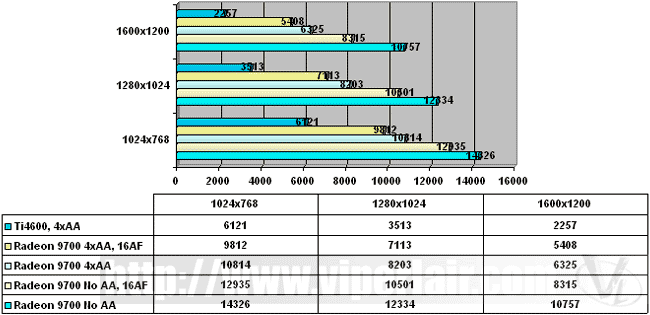
Anisotropic filtering hits the performance pretty hard, though not nearly as much as 4xAA. However, the performance hit isn't terrible, and scoring 10 000+ 3D Marks ar 12x10 with 16xAF is pretty darn impressive. The Ti4600 doesn't fare so well, and it's amazing to see the Radeon, with 4xAA and 16xAF still crush the Ti4600 with only 4xAA.
Overclocking 3D Mark
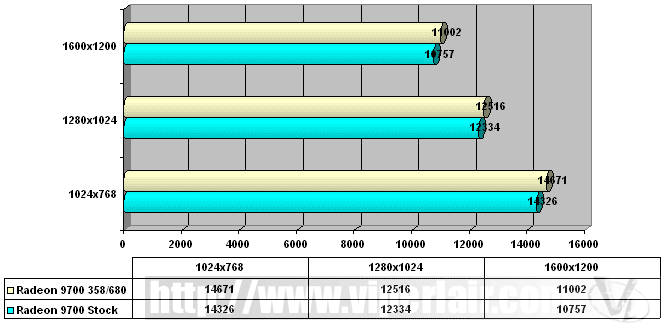
I was a little dissapointed that we couldn't get to the magical 15 000 3D Mark plateau. Either way, this is the fastest 3D Mark results to come out of our labs, and overall, we were quite pleased with the performance.
Performance Summary
I would have liked the opportunity to go over a few other Ti4600 and Radeon 9700 cards to see if differences in yields would have made a difference. I mention this because I've seen other Radeon vs Ti4600 reviews where scores have been a little closer. Both cards ran on "clean" systems, and simply put, the Ti4600 never had a chance. Is it slow? Hardly, but those Radeon benchmarks had me shaking my head. Be it stock speeds, overclocked, Anti-Aliasing and Anisotropic Filtering on or off, the Radeon 9700 was simply amazing. Heh, at 330$ - 400$ a pop, it better be.
Obviously, speed matters, but image quality is just as important, if not more so given that almost any of todays games already run fast enough.
Previous Page - Benchmarks - OpenGL
Next Page - Image Quality
|


